


Key Takeaways
- Two-thirds of Talkspace members report symptom improvement within 12 weeks, showing that Talkspace stress support extends beyond scheduled sessions.
- Online messaging therapy and video therapy offer similar outcomes, allowing flexible care that fits daily life.
- Talkspace support for stress is often covered by insurance, with many members paying little to no out-of-pocket cost.
Stress doesn't keep office hours. A difficult conversation, an unexpected bill, or a sleepless night can throw you off balance long before your next scheduled appointment, and that gap can feel like a long time. Talkspace stress support closes the gap by giving you access to a licensed therapist exactly when stress strikes. With messaging therapy available day and night, you don’t have to hold everything in until your next session.
What Makes Talkspace a Lifeline for Everyday Stress?
Everyday stress builds from work demands, relationship strains, or financial concerns, while acute stress can appear suddenly and feel overwhelming. Having consistent access to care makes it easier to respond to both. Talkspace provides ongoing access to licensed therapists and practical stress management techniques designed to fit into daily life, not just scheduled sessions.
A Talkspace longitudinal study of more than 10,000 members found that approximately two-thirds (70%) reported reduced anxiety or depression symptoms over 12 weeks of messaging therapy, with nearly one-third reaching full remission. Members consistently highlight 24/7 messaging access and the ability to connect from any location as central to their experience.
Three features define what makes this model work for everyday stress:
How Do Talkspace Therapists Help You Manage High-Stress Moments?
Talkspace therapists help you manage stress by teaching you practical coping skills, identifying stress triggers, and helping you change unhelpful thought and behavior patterns using evidence-based modalities. Cognitive-behavioral therapy (CBT) is the gold-standard treatment for anxiety and stress-related conditions, with evidence showing medium to large effect sizes across generalized anxiety, panic disorder, and social anxiety.
According to Advances in Psychiatry and Behavioral Health, internet-delivered CBT demonstrates outcomes comparable to standard in-person CBT, making therapist-guided telehealth a clinically sound option. Many therapists use evidence-based approaches like cognitive behavioral therapy (CBT) and mindfulness-based techniques to help you manage stress and build coping skills.
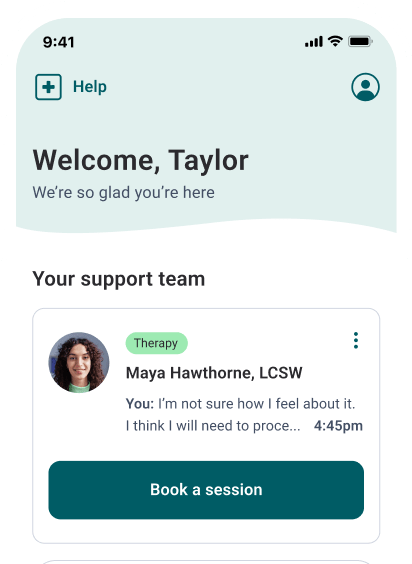
Talkspace therapists offer CBT sessions through its private, virtual platform. Plans include unlimited messaging with a licensed therapist and live online CBT sessions via video or audio. They also include expertly guided mindfulness exercises that translate into tools you can use between sessions.
For example, your therapist might guide you through a grounding exercise and provide helpful resources for reframing your thoughts in stressful situations.
Talkspace support for stress can include:
- Live video sessions for real-time support during acute stress spikes.
- Asynchronous messages (text, audio, or video) sent whenever stress surfaces, 24/7.
- Between-session exercises, such as breathing techniques or grounding cues, that are commonly assigned by CBT-focused therapists to extend gains outside formal sessions.
Online therapy for stress
Unmanageed stress can affect your life so many ways. Get help today from a licensed therapist.
Get startedThis layered approach means therapeutic contact isn't limited to a single scheduled hour each week.
Which Talkspace Features Keep You Supported Between Live Sessions?
Talkspace's between-session tools and micro-support are where the platform's stress support continues working in the background. Notifications, worksheets, and app check-ins help you feel supported when you are not in a session.
Talkcast creates personalized "podcasts" — built around your specific therapy goals — so you can revisit therapeutic guidance as often as you like. Smart Insights, an AI-powered feature, generates session-prep summaries for therapists; members whose therapists use it are one-third more likely to book and complete a timely follow-up session.
The secure messaging platform is always open. Setting a daily reminder to open the app reinforces the between-session habits your therapist recommends and keeps momentum going when stress builds.
Does Insurance Cover Talkspace Therapy?
Talkspace support for stress is more affordable than many people expect. Talkspace online therapy is often covered by insurance and is in-network with many major U.S. health plans, including Medicare and TRICARE. Most insured members pay an average copay of $10, with many paying $0.
Coverage options include:
- Health insurance: Talkspace bills your insurer directly; you typically pay only a standard copay.
- Employer benefits: Some employers cover Talkspace at no cost through a company code or Employee Assistance Plan (EAP), including online talk therapy, psychiatric care, and medication management.
Check your insurance coverage directly to see what your specific plan includes.
How You Can Start Using Talkspace for Stress Relief Today
Getting started with Talkspace stress support takes just a few steps, and most people are matched with a licensed therapist within two days of signing up.
- Create your account: Sign up on the Talkspace website or app (Google Play or IOS).
- Check your insurance: Check your coverage and out-of-pocket costs upfront, or pay out-of-pocket entirely.
- Get matched: Answer a series of assessment questions, and Talkspace connects you with a therapist based on your stated preferences and mental health goals.
- Start messaging: Once matched, you can begin sending messages right away, even before your first live session.
Stress doesn’t wait between sessions, and neither should support. Start therapy with Talkspace today and connect with a licensed therapist who meets you wherever you are.
Frequently Asked Questions (FAQs)
Is Talkspace effective for chronic stress?
Therapy through Talkspace can be effective for managing chronic stress by providing access to licensed therapists who help individuals manage stress through evidence-based modalities.
Can I message my Talkspace therapist at night?
Yes. The Talkspace platform lets you send messages to your therapist at any time, including nights and weekends, with no cap on frequency. You can express your thoughts, feelings, and what you're struggling with right at that moment. Therapists respond during their scheduled hours 5 days a week, at least once daily on active days.
Do Talkspace therapists prescribe medication for stress?
Licensed Talkspace therapists can't prescribe medication, but there are options for medication management. If prescription mental health treatment might be appropriate for you, Talkspace's psychiatric providers (different from therapists) specialize in evaluation and medication management. You can get matched with a licensed psychiatric provider, get assessed, and get a prescription if clinically warranted.
Does insurance cover stress therapy with Talkspace?
Many major insurance plans cover Talkspace services. Most insured members pay a standard copay, and many have a $0 copay.*
Sources
- Hull, T.D., Malgaroli, M., Connolly, P.S. et al. Two-way messaging therapy for depression and anxiety: longitudinal response trajectories. BMC Psychiatry 20, 297 (2020). https://doi.org/10.1186/s12888-020-02721-x. Accessed March 27, 2026.
- Onyeka OC, Riddle D, Bivins E, et al. Internet-delivered cognitive behavioral therapy for anxiety. Advances in Psychiatry and Behavioral Health. https://pmc.ncbi.nlm.nih.gov/articles/PMC11493317/. 2024 Jun;4(1):91–100. Accessed March 27, 2026.
Talkspace articles are written by experienced mental health-wellness contributors; they are grounded in scientific research and evidence-based practices. Articles are extensively reviewed by our team of clinical experts (therapists and psychiatrists of various specialties) to ensure content is accurate and on par with current industry standards.
Our goal at Talkspace is to provide the most up-to-date, valuable, and objective information on mental health-related topics in order to help readers make informed decisions.
Articles contain trusted third-party sources that are either directly linked to in the text or listed at the bottom to take readers directly to the source.