


Key Takeaways
- Sand tray therapy is an expressive, symbolic approach where clients arrange miniature figures in a sand-filled tray to process emotions without relying solely on words.
- Originally developed from Margaret Lowenfeld's World Technique and later shaped by Jungian depth psychology, this modality has been used with both children and adults.
- Evidence is strongest in pediatric populations, though some therapists also incorporate sand tray therapy with adult clients, particularly those with trauma histories.
Sand tray therapy is a hands-on, expressive form of mental health care in which clients create symbolic, three-dimensional scenes in a sand tray using miniature objects and figures. Far from a children's-only approach, it has been used across age groups from young children with limited verbal skills to adults seeking a less talk-dependent path through difficult emotions.
What makes this modality distinctive is what it sidesteps: the pressure to find the right words. By working through symbols, textures, and spatial arrangement, clients can express what language sometimes can't hold. If you are exploring this concept, it would be fruitful to understand how sand tray therapy works, who tends to benefit most, and how to find qualified support.
How Does Sand Tray Therapy Work?
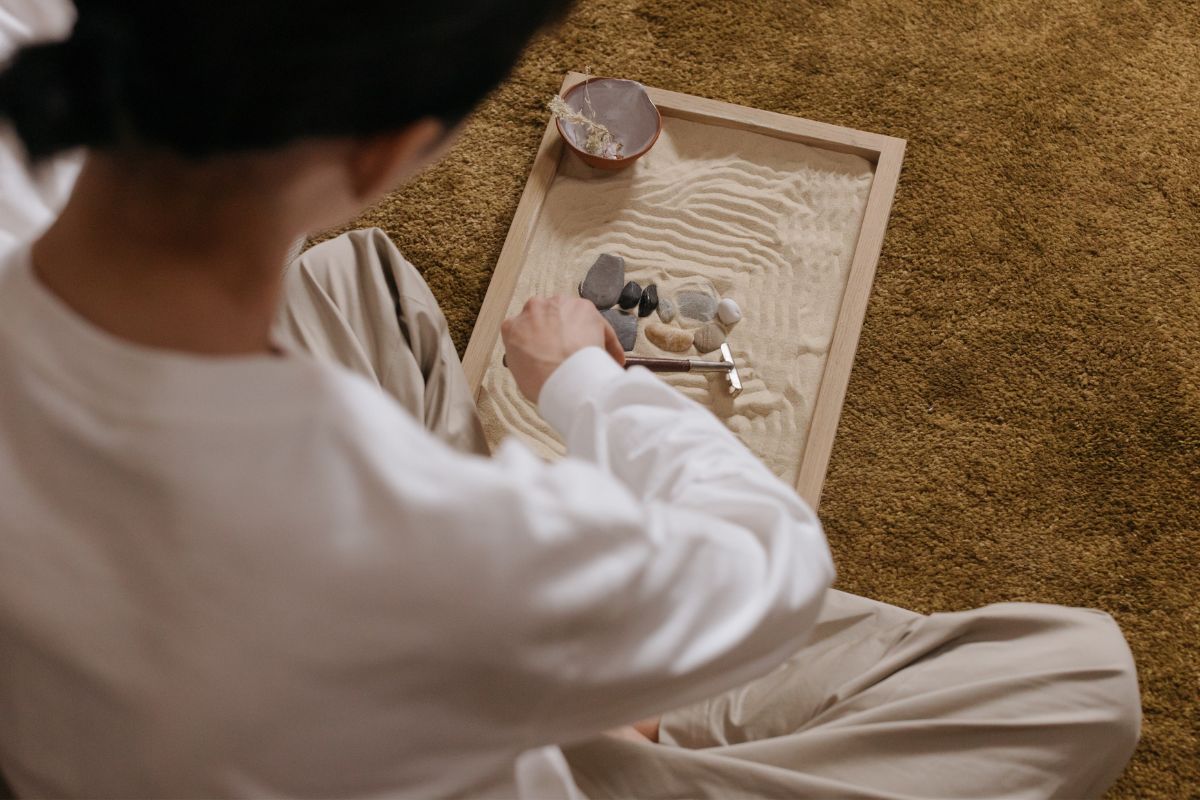
Sand tray therapy is built on a simple setup, including a bounded tray, sand, water, and a collection of miniature objects, but what unfolds within that space can be surprisingly layered. According to Counselling and Psychotherapy Research, the therapist's primary role is to establish what theorists have called a "free and protected space." It is an environment where a client can work without judgment or direction. Within that container, the client selects miniatures and arranges them freely to build a scene that reflects something from their inner world.
The bounded tray itself serves a practical function: it focuses attention and limits output to what can be held within a single session. Sand, water, and objects aren't decorative; they engage multiple senses simultaneously, offering a tactile channel for emotional material that verbal conversation alone may not reach.
A few core principles anchor how the method functions:
- Non-verbal expression: Clients communicate through symbols and spatial choices rather than words alone
- Sensory engagement: The physical properties of sand and water provide grounding and sensory input during the session
- Therapist observation: The therapist witnesses the process without directing it, holding space rather than guiding the narrative
- Reflective discussion: Once the scene is complete, the therapist and client discuss what was built
This combination of doing and then reflecting is what distinguishes sand tray therapy from talk-based approaches.
“I have used this form of therapy with children between the ages of 4-17 that are non-verbally expressive. The children had been exposed to severe trauma and it was observed that clients communicate emotions differently through symbolic play and sensory-based activities compared to traditional verbal discussion. Children were able to communicate through play, and therapists' compassionate inquiry, the way the trauma is continuing to be processed. This form of therapy validates that trauma often times can not be expressed in words.”
- Talkspace Therapist, Dr. Karmen Smith, LCSW, DD
What Is the History and Theory Behind Sand Tray Therapy?
Sand tray therapy traces back to the 1920s, when British pediatrician Margaret Lowenfeld developed a method highlighted in the World Technique at London's Institute for Child Psychology. Frustrated by the limits of talk-based approaches with children, Lowenfeld gave young clients trays of sand, water, and miniature figures, letting them build a "world" that revealed thoughts and feelings they couldn't yet put into words.
In the 1950s, Jungian analyst Dora Kalff, trained with Lowenfeld, reshaped the method into sandplay therapy, layering in Jungian concepts such as the unconscious mind and symbolic imagery to support inner growth, as highlighted by an article in Sandplay Therapists of America.
Sandplay stays closely tied to Jungian theory and is largely nondirective, with the therapist observing quietly rather than guiding or interpreting the scene aloud. Sand tray therapy, by contrast, tends to be more directive and flexible, drawing on humanistic, cognitive-behavioral, or other frameworks, with the therapist offering gentle prompts as the client builds. This humanistic branch extended sand tray work beyond childhood. Grounded in the idea that people naturally move toward growth, humanistic sandtray therapy now helps adults process stress, trauma, and relationship concerns nonverbally.
What Happens in a Sand Tray Therapy Session?
A sand tray therapy session follows a recognizable arc, though the content of each session is shaped by each client. The room is typically equipped with a waterproof tray containing sand, access to water, and a large, organized collection of miniature figures.
Objects may represent people, animals, structures, natural elements, or abstract forms. This intentional variety gives clients a broad symbolic vocabulary to utilize. Once the client begins, the therapist observes without interrupting. The scene-building process is the work. After the client is done, the therapist and client reflect on what was created together. Sessions with children tend to be more fluid and play-oriented, while adult sessions may involve more explicit reflection during the post-build discussion.
Before a first appointment, it can help to keep a few things in mind:
Licensed Therapists Online
Need convenient mental health support? Talkspace will match you with a licensed therapist within days.
Start therapy- There's no "correct" way to arrange the tray; the process is open-ended.
- Clients aren't expected to explain every choice they make.
- The therapist will typically record or document the completed scene.
- Subsequent sessions may build on earlier scenes or shift direction entirely.
Exploring different types of therapy beforehand can also help set realistic expectations for how expressive modalities differ from traditional talk-based care.
Who Is Sand Tray Therapy Best Suited For?
Children with limited verbal skills are among the most studied populations. The symbolic, play-based nature of the approach aligns naturally with how younger children process experience. Sand tray therapy's flexibility is one of its most appealing qualities. Since it doesn't require verbal fluency, it can help people who struggle to articulate their emotional experience for varied reasons.
Research has also examined sand play therapy for children with autism spectrum disorder (ASD). A 2026 systematic review published in Neuropsychiatr Dis Treat demonstrated that sandplay therapy may contribute positively to improving language function, social communication, cognitive or sensory function, and motor or behavioral function in children with ASD.
Sand tray therapy with adults has a smaller but meaningful evidence base. A doctoral dissertation in Theses and Dissertations Family Sciences found that some therapists perceive sand tray work as particularly useful with adult clients who have trauma histories, while also identifying barriers to incorporating it into adult practice.
If you're wondering whether any form of therapy might be a fit, reading about whether you need therapy can be a grounding first step.
“The children that benefited from sand therapy were the ones who felt very limited by traditional talk therapy. Sessions would be non-productive with large portions of speechless moments with the client wanting to escape the uncomfortable expectations. Incorporating expressive therapy techniques alongside more traditional talk therapy approaches can be the perfect combination in order to help process difficult emotional content.”
- Talkspace Therapist, Dr. Karmen Smith, LCSW, DD
Which Issues Can Sand Tray Therapy Help Address?
Trauma and post-traumatic stress disorder (PTSD) have received the most direct study attention. A randomized controlled trial published in the International Journal of Pediatrics among Syrian refugee children in Jordan found that both sandplay and art therapies significantly improved PTSD symptoms in conflict‐affected children, with sandplay demonstrating the greatest impact.
Here is a quick look at the primary areas where sand tray therapy is most commonly applied:
- Trauma and PTSD: Most commonly applied in children
- Behavioral challenges: Addressed primarily in pediatric settings
- Emotional processing: Used by therapists to support adults
One consistent theme across sources: sand tray therapy is best understood as one part of a broader treatment plan, not a standalone solution. A licensed therapist can help determine whether this approach fits alongside other care.
How Does Sand Tray Therapy Compare to Other Expressive Approaches?
Sand tray therapy occupies a specific space among expressive therapies, sharing qualities with art therapy and play therapy while remaining distinct in important ways.
The table below outlines key differences across modalities:
Humanistic sandtray therapy sits closer to the person-centered end of this spectrum. It emphasizes the client's autonomy in the process and overlaps with other non-directive, relationship-focused modalities. Traditional sandplay, shaped by Jungian depth psychology, tends to place more interpretive weight on the symbolic content of what's built.
What sets sand tray therapy apart from other expressive approaches is the tactile quality of sand itself. The physical act of touching, shaping, and arranging within a contained space offers a grounding, sensory dimension that visual art-making or verbal play doesn't replicate in the same way. Selecting among these modalities is best done in consultation with a licensed therapist who can assess individual needs, history, and goals rather than choosing based on description alone.
Explore Therapy Support with Talkspace
Sand tray therapy requires a specially equipped, in-person setting involving a physical tray, sand, water, and a curated collection of miniatures that aren't easily replicated through a screen. That's a real and practical consideration when thinking about access.
Not sure where to start? Talkspace makes it easy to connect with a therapist who can help you explore all your options, including whether an in-person approach, like sand tray therapy, makes sense for your unique situation. Get started today with online therapy with a licensed therapist.
Frequently Asked Questions (FAQs)
Is sand tray therapy effective for adults?
Sand tray therapy may be effective for adults by helping them explore emotions, experiences, and inner conflicts through symbolic expression. It can be a useful therapeutic approach, particularly when integrated with other forms of psychotherapy and guided by a trained therapist.
What happens during a sand tray therapy session?
During a sand tray therapy session, individuals use a tray of sand, miniature figures, and objects to create scenes or express thoughts and emotions in a symbolic way. The therapist provides a supportive environment and helps explore the meanings and feelings connected to the created scenes.
Can sand tray therapy help with trauma and anxiety?
Yes, sand tray therapy may help some individuals with trauma and anxiety by providing a safe, nonverbal way to process difficult emotions and experiences. It can support emotional expression, self-awareness, and coping when used as part of a broader therapeutic approach with a trained professional.
Is sand tray therapy only for children?
No, sand tray therapy is not only for children; it can also be used with adolescents and adults to explore emotions, experiences, and personal challenges. Many adults find it helpful for self-reflection, trauma processing, and gaining insight through symbolic expression.
How long does a sand tray therapy session typically last?
A typical sand tray therapy session usually lasts about 45 to 60 minutes, although the duration may vary depending on the therapist’s approach and the individual’s needs. The time may include creating the sand tray scene, discussing its meaning, and reflecting on emotions or insights that emerge.
Talkspace articles are written by experienced mental health-wellness contributors; they are grounded in scientific research and evidence-based practices. Articles are extensively reviewed by our team of clinical experts (therapists and psychiatrists of various specialties) to ensure content is accurate and on par with current industry standards.
Our goal at Talkspace is to provide the most up-to-date, valuable, and objective information on mental health-related topics in order to help readers make informed decisions. Articles contain trusted third-party sources that are either directly linked to in the text or listed at the bottom to take readers directly to the source.